
At a glance
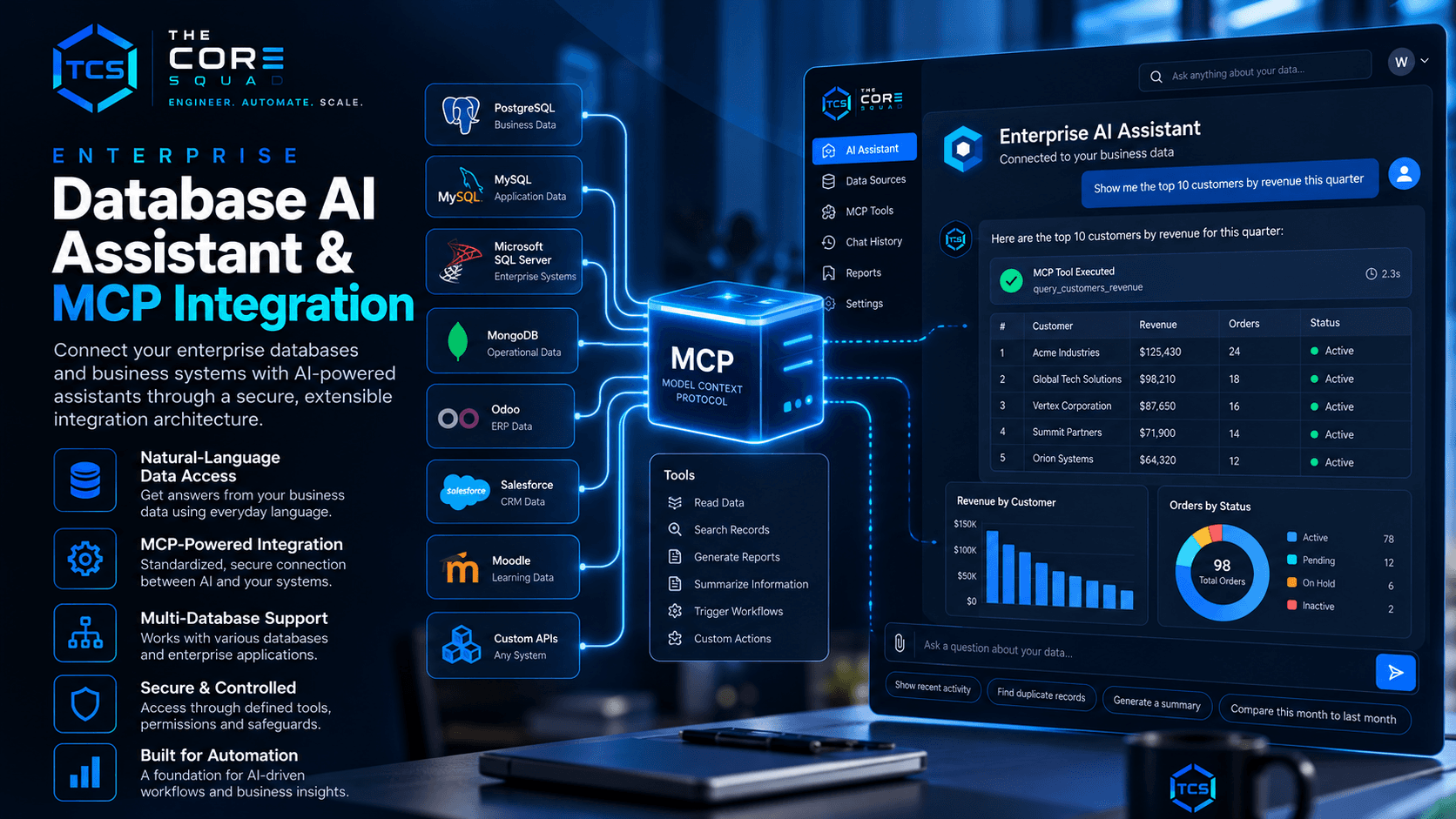
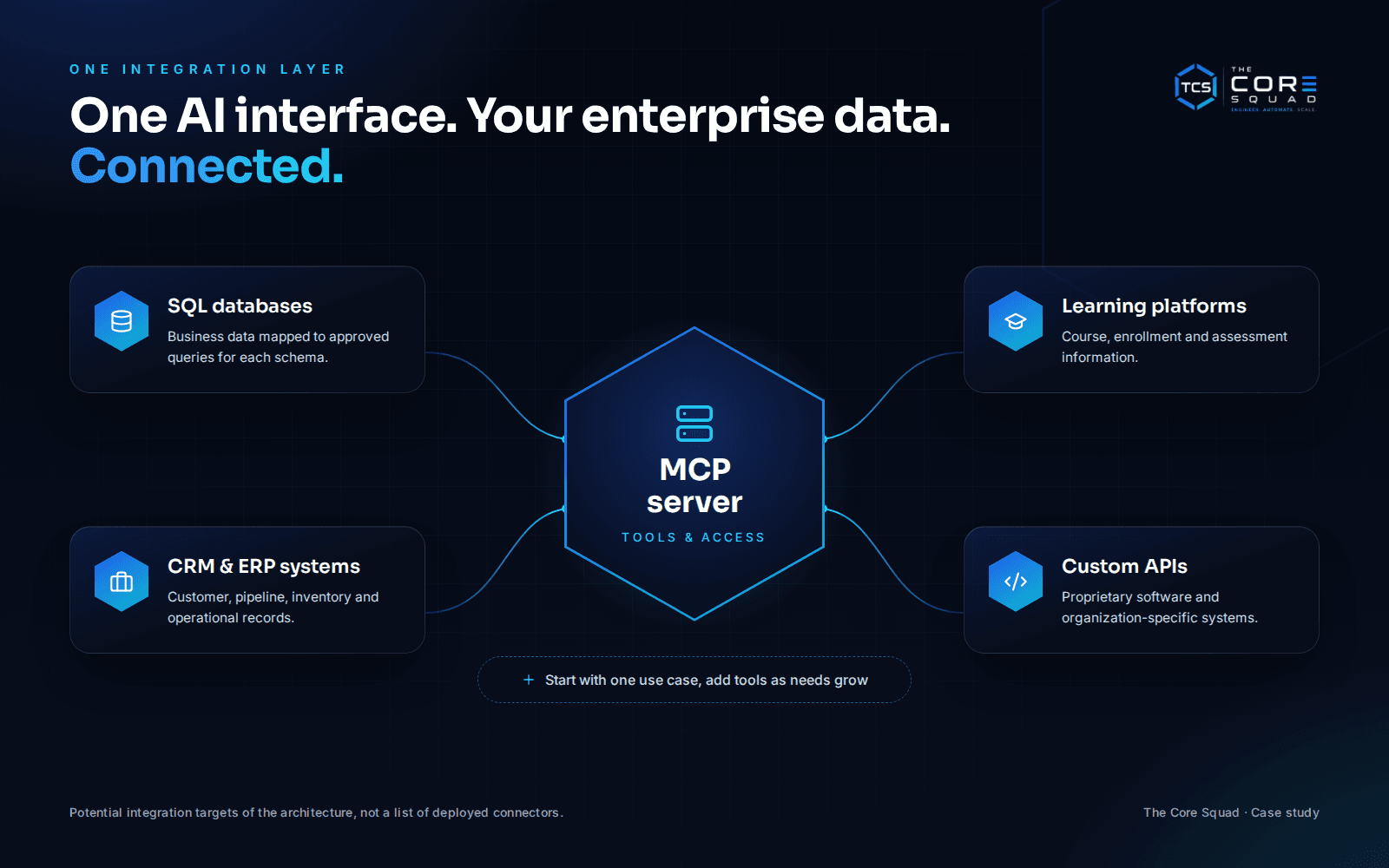
“One AI interface. Your enterprise data. Connected, through defined tools that decide exactly what the assistant can read or do.”
The challenge
The data existed, but only developers and fixed reports could get to it.
Customer records, transactions, learning data, and financial information were spread across separate databases and applications. Getting an answer outside existing dashboards meant writing SQL, knowing the data structures, or waiting on a developer. Connecting AI to that data also raised real questions about permissions, query safety, and data exposure.
- Information locked inside systems that need application-specific interfaces
- Questions that require SQL and knowledge of database relationships
- Separate apps for CRM, learning, operations, and reporting
- Predefined dashboards that can't answer every new question
- AI access that must be controlled, not an open database connection
Platform intelligence
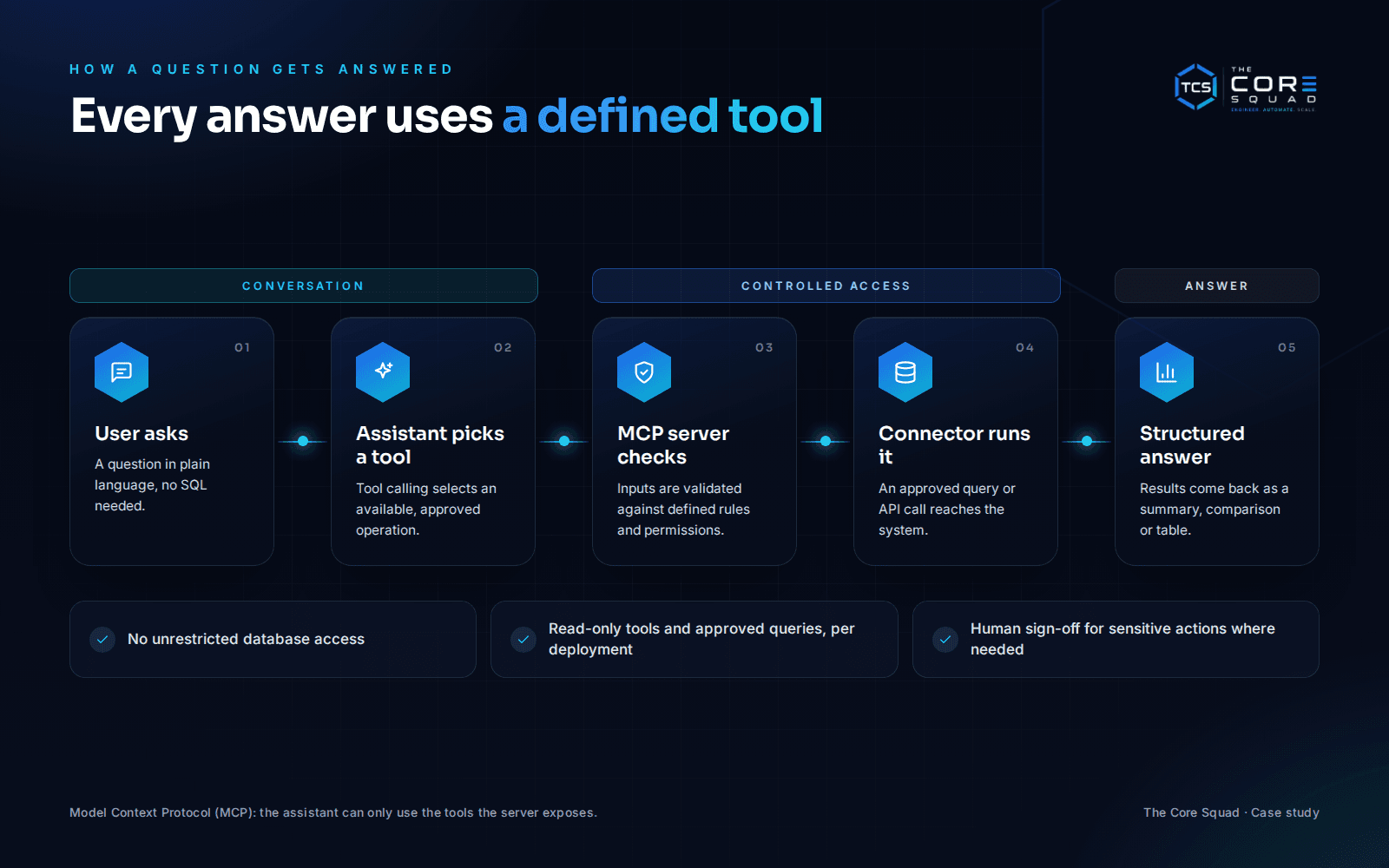
“The assistant never gets the keys to the database. It can only call the tools the MCP server exposes, each with defined inputs, validation, and access rules, and it answers from what those tools return.”
What we built
Everything inside this engagement.
MCP Server Development
- Custom MCP servers exposing defined tools and resources
- One integration layer reused by compatible AI clients
- Standardized discovery instead of one-off integrations
Natural-Language Data Access
- Users ask questions in everyday language
- The assistant selects an available tool and reads its result
- Answers formatted as summaries, comparisons, or tables
Database & API Connectivity
- Database-independent connectors built around each schema
- SQL databases and application data exposed through APIs
- Mapping, query controls, and access configuration per system
Controlled Tool Execution
- Defined operations instead of unrestricted database access
- Input validation, execution limits, and authorization checks
- Read-only tools and human confirmation, where a deployment needs them
Gallery
Inside the product.
Build & infrastructure
The stack behind it.
Our approach
We developed custom MCP servers that sit between the AI assistant and each data source. Connectors map business operations to approved queries or API calls, every tool defines and validates its inputs, and the assistant uses tool calling to pick the right one and turn the result into a summary, comparison, or table. Controls such as read-only tools, approved query patterns, logging, and human confirmation for sensitive actions are applied per deployment.
The result
Business users can ask questions in plain language and get answers from supported systems, complementing existing dashboards, with one reusable integration layer that compatible AI clients share and that can grow from one focused use case to more systems and workflows.
MCP is an open standard that lets AI applications discover and call external tools and data sources in a consistent way. An MCP server exposes defined tools, and any compatible AI client can use them.
No. The assistant can only call the tools the MCP server exposes. Each tool has defined inputs, validation and access rules, so the AI never runs open-ended queries against your database.
The approach is database independent. Connectors can be built for SQL databases such as PostgreSQL, MySQL and SQL Server, and for CRM, ERP, LMS or custom systems that expose an API.
That is decided per deployment. Many start with read-only tools and approved query patterns, and add write actions later with human confirmation for anything sensitive.
Next
Want a result like this?
AI Agents
The service behind this project.
Enterprise Technology & Business OperationsEnterprise AI Knowledge Assistant
Turning scattered business documents into answers employees can simply ask for
Education Technology & Professional TrainingAI Exam Proctoring
AI-powered exam proctoring and assessment automation inside an enterprise LMS
Logistics & FleetAI Fleet Safety Monitoring
Cut fleet accident rates by 45% with real-time AI safety monitoring