
At a glance
“A conversational assistant that finds the relevant parts of an organization's documents first, then answers from them, instead of relying on what a language model happens to know.”
The challenge
The answers existed, but finding them took too long.
Knowledge was spread across policies, technical documentation, and operational procedures. Keyword search returned documents rather than answers, so employees read through long files or interrupted experienced colleagues. A general-purpose AI model was not the fix either, because its answers would not be grounded in the organization's own documentation.
- Business information fragmented across many documents and repositories
- Keyword search that returns files instead of answering the question
- Recurring questions landing on the same subject matter experts
- AI answers that need to be grounded in the company's actual documents
- Documentation that keeps growing and changing over time
Platform intelligence
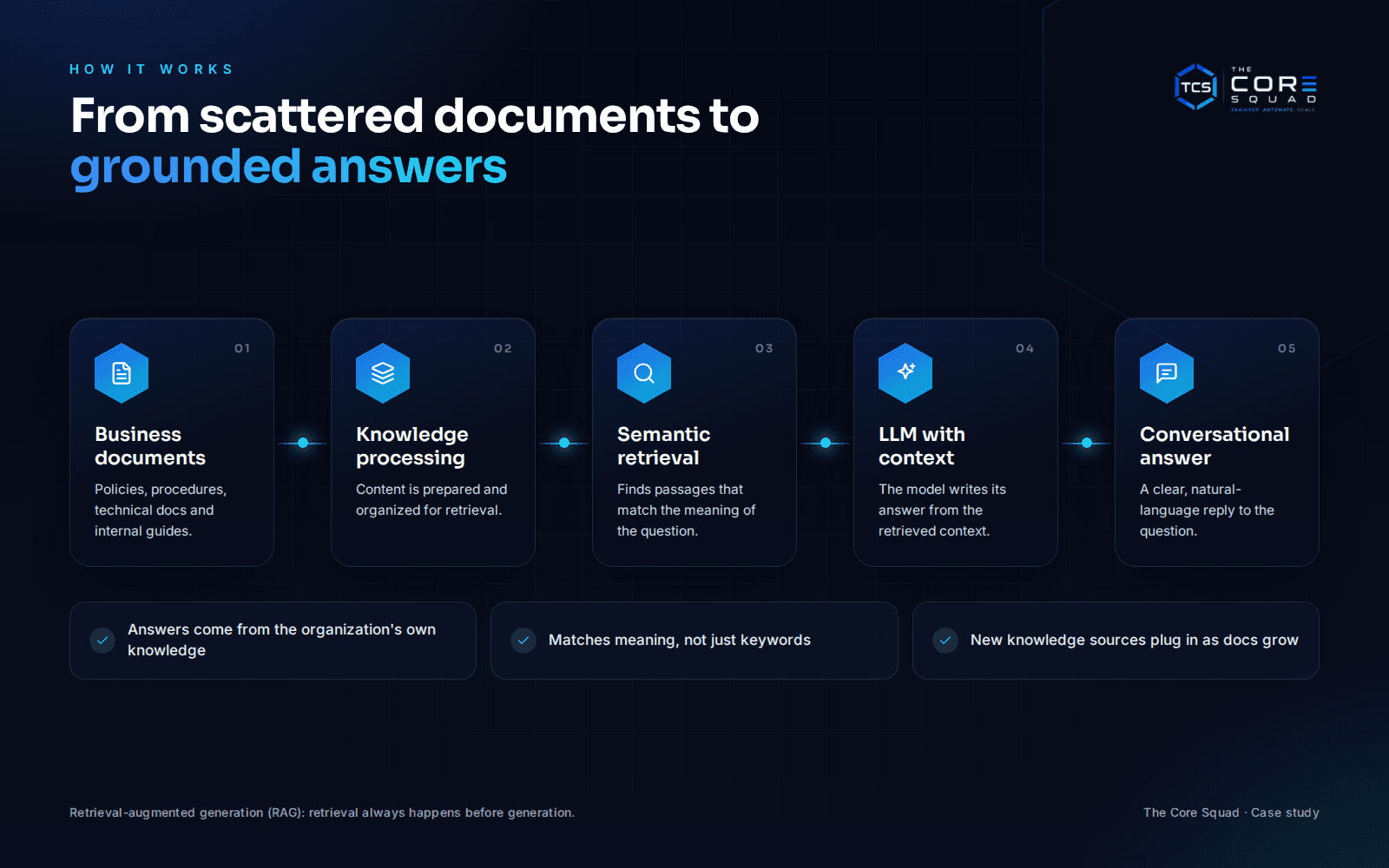
“Every answer starts with retrieval: the assistant finds the passages in the organization's documents that match the meaning of the question, then gives them to the language model as context. Documents, then knowledge processing, then retrieval, then the LLM, then a conversational answer.”
What we built
Everything inside this engagement.
AI-Powered Knowledge Retrieval
- Retrieval-augmented generation finds relevant knowledge before answering
- Natural-language questions instead of manual document searches
- Answers aligned with the organization's own resources
Document-Based Intelligence
- Business documents processed and organized for retrieval
- Works with operational docs, technical resources, and internal procedures
- Semantic search that matches meaning, not just keywords
Conversational AI Interface
- Ask questions naturally, without knowing file names or locations
- Accessible to users at every level of technical experience
- Retrieved context passed to the LLM for grounded responses
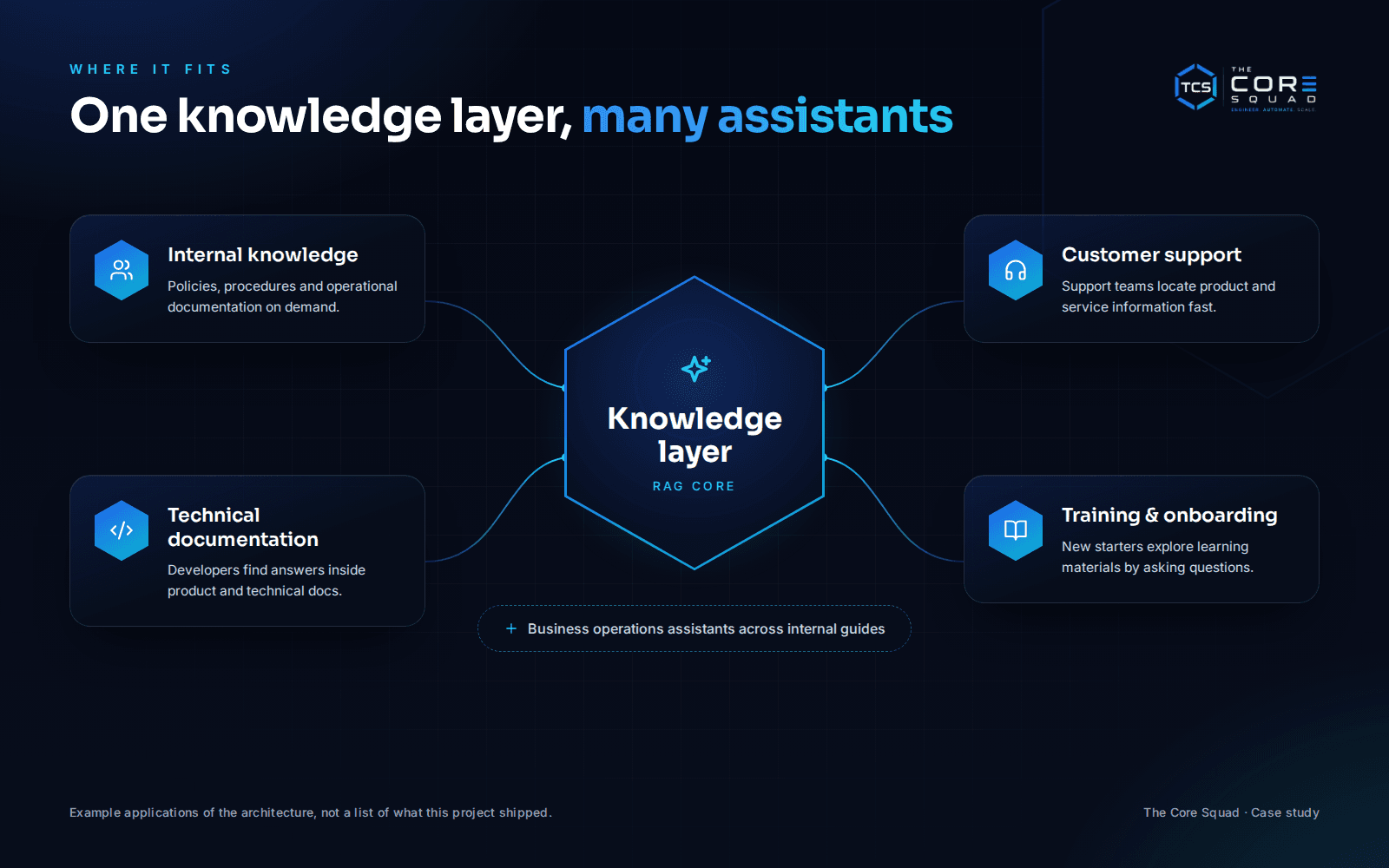
Extensible Knowledge Architecture
- Built to add new knowledge sources as documentation grows
- Ready for integrations with business systems and workflows
- A foundation for specialized assistants: support, onboarding, technical docs
Gallery
Inside the product.
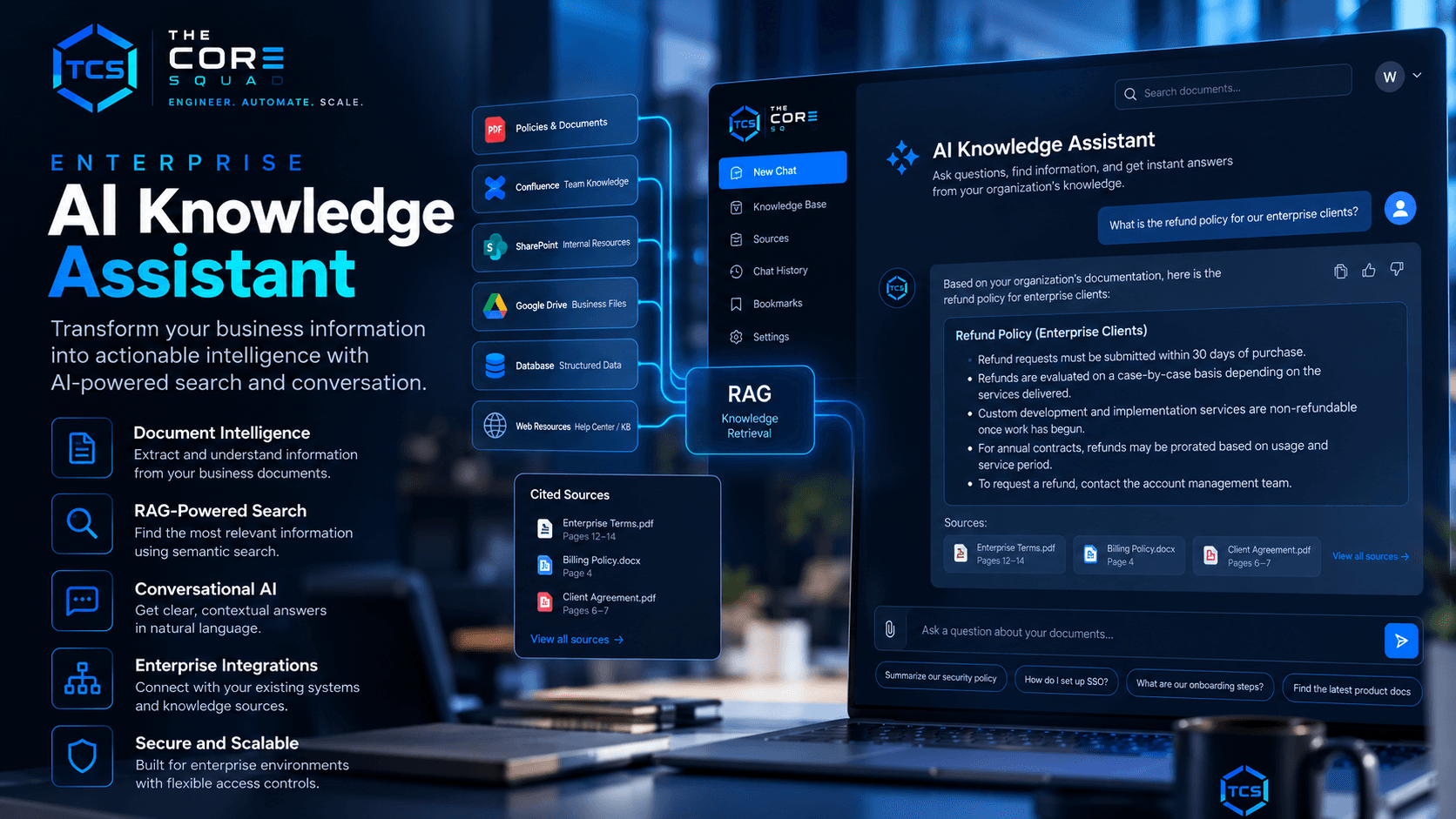
Build & infrastructure
The stack behind it.
Our approach
We built a retrieval-augmented generation pipeline: business documents are processed and organized for retrieval, a semantic search layer matches questions to relevant passages even when the wording differs, and an LLM writes a conversational answer from that context. A user-facing chat interface sits on top, on an architecture designed to take on new knowledge sources and integrations.
The result
Employees can ask questions in everyday language and get answers drawn from the organization's own knowledge, with fewer manual steps to find information, fewer repeat questions to experts, and a foundation for more specialized assistants and business system integrations.
Retrieval-augmented generation (RAG) means the assistant first searches your own documents for the passages that match a question, then gives them to a language model as context, so answers come from your knowledge rather than the model's general training.
A general chatbot answers from what the model learned on the public internet. This assistant retrieves from your policies, procedures and technical docs first, so its answers are grounded in your organization's information.
Yes. Semantic search matches meaning, not exact keywords, so a question still finds the right passage when the user's words differ from the source.
For high-impact decisions, yes. Grounding in your documents makes answers far more reliable, but like any AI system, important answers should be checked against the source.
Next
Want a result like this?
AI Agents
The service behind this project.
Enterprise Technology & Business OperationsEnterprise Database AI Assistant & MCP Integration
Connecting AI assistants to enterprise databases and business apps through the Model Context Protocol
Education Technology & Professional TrainingAI Exam Proctoring
AI-powered exam proctoring and assessment automation inside an enterprise LMS
Logistics & FleetAI Fleet Safety Monitoring
Cut fleet accident rates by 45% with real-time AI safety monitoring